
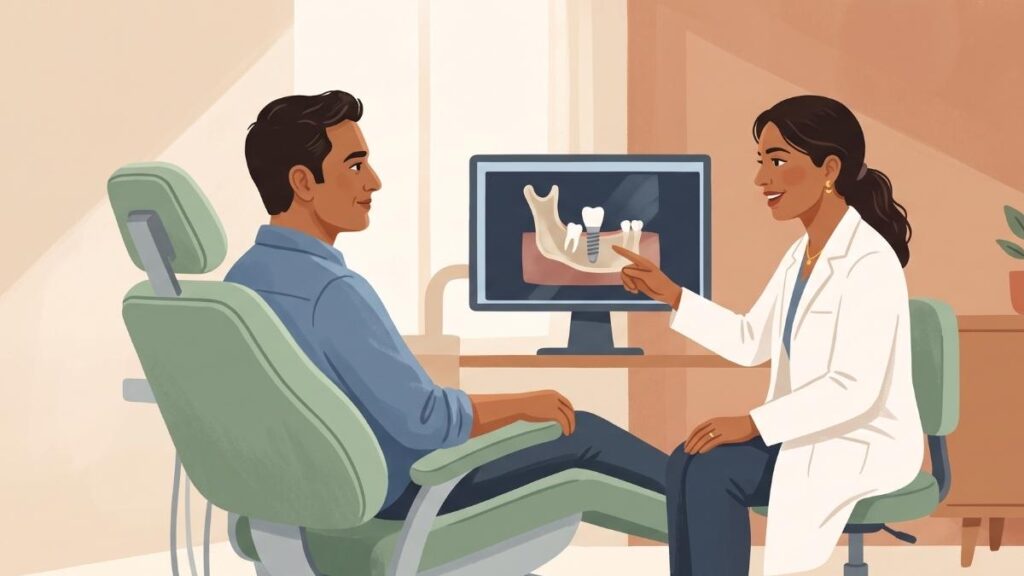
Short answer: A dental implant replaces a missing tooth with a titanium post screwed into the jawbone, topped with a crown that looks and works like a real tooth. The full process takes 3 to 6 months because the bone needs time to fuse around the implant. The surgery itself takes 30 to 60 minutes under local anaesthesia — similar to getting a tooth pulled. It’s the most expensive dental treatment, but it’s also the only one that can last a lifetime.
Losing a tooth changes things. You chew differently, you smile differently, and if it’s visible, you think about it more than you’d expect. A dental implant is the closest thing to getting your real tooth back. But it’s also expensive, it takes months, and the internet is full of confusing information — some from clinics trying to sell you their brand of implant, some from people sharing horror stories.
This guide is written from the patient’s side. What actually happens at each stage, what it feels like, what it costs, and what questions to ask before you commit.
What a dental implant actually is
A dental implant has three parts:
- The implant (fixture): A small titanium screw, about 8 to 13 mm long, placed into your jawbone. This becomes the artificial root.
- The abutment: A connector piece that screws onto the top of the implant, sticking out above the gum line.
- The crown: The visible tooth-shaped part that sits on top of the abutment. Made of ceramic or zirconia, it’s custom-matched to your other teeth.
Titanium is used because it’s biocompatible — your body doesn’t reject it. Over 8 to 16 weeks, the jawbone grows around the implant and locks it in place. This process is called osseointegration, and it’s why implants are so stable. Once fused, an implant can handle the same biting force as a natural tooth.
Are you a candidate for an implant?
Not everyone can get an implant immediately. Your dentist will assess:
- Bone quantity: There needs to be enough jawbone to hold the implant. If a tooth has been missing for years, the bone in that area may have shrunk. This can often be fixed with bone grafting, but it adds time and cost.
- Bone quality: Bone density matters. An X-ray or CT scan reveals this.
- Gum health: Active gum disease (periodontitis) needs to be treated first. Placing an implant in infected gums is a recipe for failure.
- General health: Uncontrolled diabetes, heavy smoking, radiation therapy to the jaw, or certain medications (like bisphosphonates for osteoporosis) can affect healing. These don’t always rule out implants, but your dentist needs to know about them.
- Age: Implants are generally placed after jaw growth is complete — around 18 for women, 21 for men. There’s no upper age limit. People in their 70s and 80s get implants successfully.
If you’ve been told you’re “not a candidate,” get a second opinion — ideally from an implantologist (a dentist who specialises in implants). What one dentist considers too little bone, another may handle with grafting or a different implant design.
The consultation — what happens first
Before anything is placed, you’ll have a detailed assessment. This typically includes:
- Clinical examination of the gap, surrounding teeth, and gums.
- X-rays — a panoramic X-ray (OPG) shows the full jaw. Many implant dentists also take a CBCT scan (3D cone beam CT), which gives a precise 3D map of your bone. This is more expensive but significantly improves planning accuracy.
- Photographs of your mouth and face.
- Medical history discussion — medications, conditions, allergies, smoking habits.
- Treatment plan — which implant brand, whether bone grafting is needed, timeline, and total cost broken down.
Questions to ask at the consultation
- Which implant brand are you using, and why?
- Do I need bone grafting? If yes, what kind and how much does it add?
- What’s the total cost — implant, abutment, crown, and any grafting?
- How many implants have you placed? (Experience matters significantly with implants.)
- What’s your success rate?
- What happens if the implant fails — is replacement covered?
- Will you do the surgery and the crown, or will I see different specialists?
- How long will the entire process take from start to final crown?
Get the total cost in writing. The implant fixture, abutment, crown, any grafting, the CBCT scan, and follow-up visits — these are often billed separately, and the “implant cost” quoted on a clinic’s website usually means only the fixture, not the full treatment.
The procedure, phase by phase
Phase 1: Bone grafting (if needed) — adds 3 to 6 months
If your jawbone has shrunk where the tooth is missing, your dentist may need to build it up before placing the implant. This is called bone grafting.
What happens: Under local anaesthesia, the dentist opens the gum, places bone graft material (synthetic, bovine, or from another part of your jaw), covers it with a membrane, and stitches the gum closed. The graft needs 3 to 6 months to integrate with your existing bone before the implant can be placed.
A sinus lift is a specific type of graft needed for upper back teeth, where the sinus cavity sits close to the jawbone. It lifts the sinus floor and packs bone material underneath.
Not everyone needs grafting. If your tooth was recently extracted and there’s sufficient bone, you may skip directly to implant placement. In some cases, a small graft is done at the same time as the implant — no extra waiting period.
Phase 2: Implant placement surgery (30 to 60 minutes)
This is the main event, and it’s simpler than most people expect.
Before the surgery
Eat a normal meal two to three hours before. Your dentist may prescribe an antibiotic to start the day before, and an anti-anxiety medication if you’re nervous. Arrange for someone to drive you home if sedation is used.
The surgery, step by step
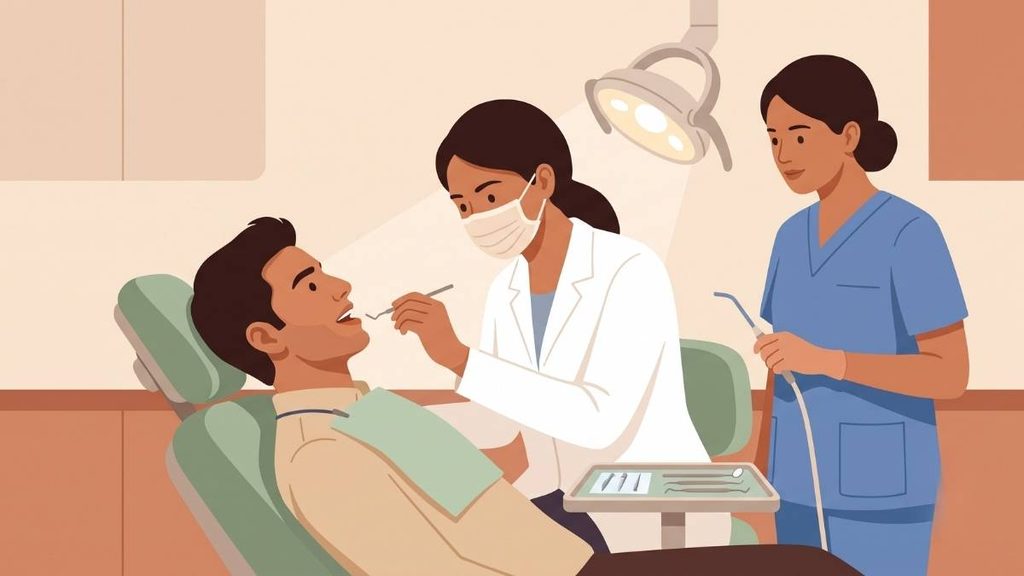
- Anaesthesia (5 minutes). Local anaesthetic is injected around the implant site — the same injection used for fillings or extractions. You’ll be awake but won’t feel pain. Some clinics offer IV sedation (you’re conscious but deeply relaxed) or general anaesthesia for anxious patients or multiple implants — these cost extra.
- Incision (2 minutes). A small cut is made in the gum to expose the bone underneath. In some techniques (flapless surgery), a small punch removes a circle of gum tissue instead of a full incision. This heals faster but isn’t suitable for every case.
- Drilling the site (5 to 10 minutes). Using a series of increasingly wider drills, the dentist creates a precise hole in the jawbone. This is done at controlled speed with saline irrigation to prevent overheating the bone — overheating is one of the main causes of implant failure, and experienced implantologists are meticulous about this. You’ll feel vibration and pressure, not pain.
- Placing the implant (2 to 5 minutes). The titanium implant is screwed into the prepared hole. The dentist checks the insertion torque — how tightly it goes in — which indicates initial stability. Higher torque is better.
- Closing (5 minutes). A healing cap or cover screw is placed on top of the implant, and the gum is stitched closed over it (submerged technique) or around the healing cap (non-submerged technique, where the cap sticks out slightly above the gum).
- Post-op X-ray. A quick X-ray confirms the implant is positioned correctly.
The whole surgery takes 30 to 60 minutes for a single implant. Multiple implants take longer but are often done in one session.
What it feels like during
Pressure and vibration, especially during drilling. The sound of the drill is the part most people dislike — it’s louder than a filling drill because it’s working through bone. Earphones with music help. There should be no sharp pain at any point — if you feel any, raise your hand and more anaesthesia will be given.
Phase 3: The healing period (8 to 16 weeks)
This is the longest phase, and nothing visible happens. The implant is sitting inside your jawbone, and the bone is slowly growing around it and locking it in place (osseointegration). You can’t rush this.
During this time:
- The implant site heals externally within 7 to 14 days.
- Stitches are removed after 7 to 10 days (or dissolve on their own).
- You may wear a temporary tooth — a removable partial denture or a temporary bridge — so the gap isn’t visible. Some clinics offer an immediate temporary crown on the implant itself, but this depends on how stable the implant was at placement.
- You’ll have one or two check-up visits during this period.
Lower jaw implants typically heal in 8 to 12 weeks. Upper jaw implants take 12 to 16 weeks because upper jawbone is less dense.
Phase 4: Abutment and impression (2 visits over 1 to 2 weeks)
Once the implant has integrated:
- Uncovering (if submerged). A small cut in the gum exposes the top of the implant. A healing abutment is placed — a small metal collar that shapes the gum around the implant into the right contour for the final crown. This heals in 1 to 2 weeks.
- Impression. The dentist takes a mould or digital scan of the implant position and your surrounding teeth. This is sent to a dental lab, which fabricates your custom crown.
Phase 5: The final crown (30 minutes)
The permanent crown is tried in, checked for fit, bite, and colour match, and then either screwed or cemented onto the abutment. Your dentist adjusts the bite if needed.
You walk out with a tooth that looks, feels, and functions like a natural one. No special care beyond normal brushing and flossing.

After the implant surgery — recovery
Day 1
Some bleeding is normal for the first few hours — bite on gauze if needed. Swelling starts building and peaks around day 2 to 3. Your mouth stays numb for 2 to 4 hours after surgery.
What to do: Apply an ice pack (wrapped in a towel) on the outside of your cheek — 15 minutes on, 15 minutes off. Take the prescribed painkillers before the numbness wears off. Eat cold, soft food — yogurt, smoothies, mashed dal, cold soup. Don’t spit, don’t use a straw, don’t rinse vigorously — these can dislodge the blood clot.
Days 2 to 5
Swelling peaks and then gradually subsides. Bruising on the cheek or jaw is normal, especially in older patients — it looks worse than it is and fades within a week. Pain is manageable with ibuprofen and paracetamol, often alternated.
Switch to warm soft food after 48 hours — khichdi, idli, scrambled eggs, dal rice, banana. Avoid chewing on the implant side for at least 2 weeks.
Days 5 to 14
Most discomfort is gone. External healing is nearly complete. Stitches come out around day 7 to 10. You can gradually return to normal food, but avoid hard or crunchy food on the implant side for 6 to 8 weeks.
When to call your dentist
- Pain that gets worse after day 3 instead of better
- Swelling that increases after day 3
- Fever above 101°F
- Pus or foul taste from the surgery site
- Numbness in lip or chin that doesn’t go away after 24 hours (rare, but important — may indicate nerve proximity)
- The implant feels loose
How much does a dental implant cost in India?
This is where the confusion lives. “Dental implant ₹15,000” on a clinic’s board usually means just the fixture — not the abutment, not the crown, not the CBCT scan, not any grafting. The real cost is the total of everything.
Typical total treatment cost (implant + abutment + crown) across Indian cities:
- Indian implant brands (Myriad, Adin, Equinox): ₹15,000 – ₹30,000 total
- Korean brands (Osstem, Dentium, NeoBiotech): ₹25,000 – ₹45,000 total
- Premium European/American brands (Nobel Biocare, Straumann, Zimmer): ₹45,000 – ₹80,000 total
Additional costs that may apply:
- CBCT scan: ₹1,500 – ₹3,500
- Bone grafting: ₹5,000 – ₹20,000 depending on type and extent
- Sinus lift: ₹15,000 – ₹30,000
- IV sedation: ₹5,000 – ₹15,000
- Temporary tooth during healing: ₹2,000 – ₹5,000
Metro cities are at the higher end, tier-2 and tier-3 cities lower. The implant brand accounts for the biggest price difference — not the dentist’s skill. An experienced implantologist using a Korean brand may deliver better results than an inexperienced dentist using Nobel Biocare.
Check detailed dental treatment costs in your city →
Indian vs imported implants — what’s the real difference?
This is the most common question patients research, and the answer is more nuanced than most clinics admit.
What premium brands offer: Nobel Biocare, Straumann, and Zimmer have 30 to 50+ years of published research, long-term clinical studies proving 95%+ success rates over 20 years, advanced surface treatments that may improve osseointegration, and a global network meaning any dentist worldwide can work on your implant. Their components are precision-machined to tighter tolerances.
What Indian and Korean brands offer: Modern manufacturing that often matches premium brands in basic design. Korean brands like Osstem are now among the most-placed implants globally, with growing research backing them. Indian brands are newer with less long-term data, but cost a fraction of European brands.
The practical reality: For a straightforward single implant with good bone, the brand matters less than the dentist’s skill. The implant design has been refined for decades — the basic science works across brands. Where premium brands may have an edge is in complex cases (poor bone, aesthetic zone, multiple implants) and in long-term component availability — will replacement parts for your implant be available in 15 years?
Ask your dentist which brand they use most and why, rather than insisting on the most expensive option. Volume and familiarity with a system often matters more than the brand name on the box.
Common fears, addressed plainly
“Implant surgery is extremely painful”
The surgery itself is painless under local anaesthesia — many patients say it was easier than the extraction that created the gap in the first place. The recovery involves 3 to 5 days of manageable discomfort, less painful than a wisdom tooth removal for most people. The drill sound is the worst part, not the sensation.
“The implant might get rejected by my body”
Titanium implants don’t trigger immune rejection — titanium is one of the most biocompatible materials known. What can happen is failure to osseointegrate (the bone doesn’t fuse with the implant), which occurs in about 2 to 5% of cases. Common causes: infection, smoking, insufficient bone, overloading the implant too early, or the implant overheating during placement. If it fails, the implant is removed (painlessly — it’s loose), the site heals for a few months, and a new implant is usually placed successfully.
“I’m too old for an implant”
Age alone is not a barrier. If you’re healthy enough for a tooth extraction, you’re healthy enough for an implant. Patients in their 70s and 80s get implants routinely. The key factors are bone quality and general health, not age.
“A bridge is just as good and cheaper”
A bridge works, but it requires grinding down the two healthy teeth on either side of the gap to support the bridge. Those teeth are permanently altered. The bridge itself lasts 10 to 15 years on average before needing replacement, during which those anchor teeth may develop problems. An implant leaves adjacent teeth untouched and can last a lifetime. Over 20 years, the total cost often favours the implant.
“What if I need an MRI later?”
Titanium dental implants are MRI-safe. They don’t move or heat up in an MRI machine. They may cause a small artifact (shadow) on the scan in the jaw area, but this doesn’t prevent the MRI from being performed or read. Inform the radiologist you have dental implants, but there’s no medical reason to avoid MRI.
How to choose an implant dentist
Implant placement is a skill-dependent procedure. The same implant brand placed by two different dentists can have very different outcomes. Things that matter:
- Volume: How many implants has this dentist placed? Someone who places 5 to 10 implants a month has different hands than someone who does 2 a year. Ask directly.
- Specialisation: Oral surgeons, prosthodontists, and periodontists all place implants as part of their specialist training. General dentists can too, but check their implant-specific training and experience.
- CBCT planning: A dentist who plans your implant on a 3D CBCT scan is working with much better information than one who relies only on a 2D OPG X-ray. If your dentist doesn’t take a CBCT, ask why.
- Surgical guide: For complex cases, some dentists use a 3D-printed surgical guide — a custom template that fits over your teeth and guides the drill to the exact planned position. This improves accuracy. It’s not necessary for every case, but it’s a sign of careful planning.
- Follow-up protocol: A dentist who schedules regular follow-ups (1 week, 1 month, 3 months, 6 months, then annually) is managing outcomes, not just placing and forgetting.
Implant care — how to make it last
An implant can’t get a cavity — it’s titanium and ceramic. But it can develop peri-implantitis, which is the implant equivalent of gum disease. The gum and bone around the implant get infected, and if untreated, the implant loosens and fails. This is the leading cause of implant loss after the first year.
Prevention is straightforward:
- Brush twice daily, paying attention to where the crown meets the gum.
- Floss or use an interdental brush around the implant daily.
- A water flosser is particularly useful for implants — it cleans areas that regular floss struggles with.
- Don’t smoke. Smoking is the single biggest risk factor for implant failure, both during healing and long-term.
- Visit your dentist every 6 months for a check-up and cleaning. The dentist checks the implant’s stability, the gum health around it, and takes an X-ray annually to monitor the bone level.
With proper care, a dental implant can last 20 to 30 years — many last a lifetime. The crown on top may need replacement after 10 to 15 years due to normal wear, but replacing a crown is simple and much cheaper than the original implant.
Full mouth implants — replacing all teeth
If you’re missing most or all teeth, individual implants for every tooth (28 to 32 implants) aren’t practical or necessary. Instead, an entire arch of teeth can be supported by 4 to 6 implants using techniques like:
- All-on-4: Four implants support a full arch of 12 to 14 teeth. Two implants go in straight at the front, two are angled at the back to maximise bone contact. A temporary full bridge is often placed the same day as surgery.
- All-on-6: Six implants for even more support, used when bone allows.
- Implant-supported overdenture: Two to four implants with snap-on attachments hold a removable denture securely. Less expensive than fixed bridges, and the denture clicks firmly in place instead of floating on the gums.
Full arch treatment costs ₹2 to ₹6 lakh per jaw depending on the technique, brand, and city. This is a complex treatment that requires experienced hands — choose your dentist carefully for this one.
Frequently asked questions
How long does the entire implant process take?
3 to 6 months from implant placement to final crown, assuming no bone grafting is needed. With grafting, add 3 to 6 months before the implant can be placed. The surgery itself is 30 to 60 minutes — it’s the healing time that makes the overall process long.Does implant surgery hurt?
The surgery is painless under local anaesthesia. Afterwards, expect 3 to 5 days of swelling and soreness managed with over-the-counter painkillers. Most patients say it was less painful than the tooth extraction. The drill sound is more unpleasant than the sensation.Can I get an implant the same day a tooth is extracted?
Sometimes, yes. This is called immediate implant placement — the implant goes into the extraction socket the same day the tooth comes out. It requires sufficient bone and no active infection. Your dentist will assess whether your case qualifies. It saves 3 to 4 months of waiting but isn’t suitable for everyone.How long does a dental implant last?
The implant itself (the titanium screw) can last 20 to 30 years, often a lifetime. The crown on top typically lasts 10 to 15 years before needing replacement due to normal wear. Proper oral hygiene and regular dental visits are the biggest factors in longevity.What’s the success rate of dental implants?
Overall success rates are 95 to 98% over 10 years. Risk factors that lower success include smoking (drops to about 85 to 90%), uncontrolled diabetes, poor oral hygiene, and insufficient bone. An experienced implantologist working with good planning typically achieves above 97%.Should I get an Indian implant or an imported one?
For a straightforward single implant with good bone, the dentist’s skill matters more than the brand. Korean brands (Osstem, Dentium) offer a good middle ground — globally proven with extensive research, at half the price of European brands. Premium brands (Nobel, Straumann) may have an edge in complex cases and long-term component availability. Ask your dentist what they use most and trust their experience.Can a diabetic patient get a dental implant?
Yes, if diabetes is well-controlled (HbA1c below 7 to 8%). Uncontrolled diabetes impairs healing and increases infection risk, lowering implant success rates. Get your diabetes under good control before implant surgery, and inform your implantologist about your condition and medications.Is a dental implant covered by insurance?
Most dental insurance policies in India do not cover implants, or cover only a small portion. Some corporate policies and premium plans offer partial coverage (₹10,000 to ₹25,000 per implant). Check your specific policy. Many clinics offer EMI options through Bajaj Finserv, ZestMoney, or in-house payment plans for treatments above ₹10,000.
Next step
If you’re considering a dental implant, the most useful thing you can do right now is get a proper consultation with a CBCT scan. This tells you definitively whether you have enough bone, what kind of implant suits your case, and what the total cost will be. A consultation commits you to nothing — it gives you the information to decide.
If cost is the main hesitation, ask about Korean implant brands and EMI options. A well-placed Korean implant by an experienced dentist is a far better investment than no implant at all.
Find a dental implant specialist near you →
About this article. This is a general guide to dental implants from the patient’s perspective, written with AI assistance. It contains no diagnosis, treatment advice or clinical recommendations. Treatment plans vary between dentists, and anything relating to your own teeth, bone condition, health status, or treatment options should be discussed with a qualified dental implantologist who has examined you.
Are you a practising implantologist? We’re happy to publish a professional review note on this page with your name, qualification and clinic link. Get in touch.
