
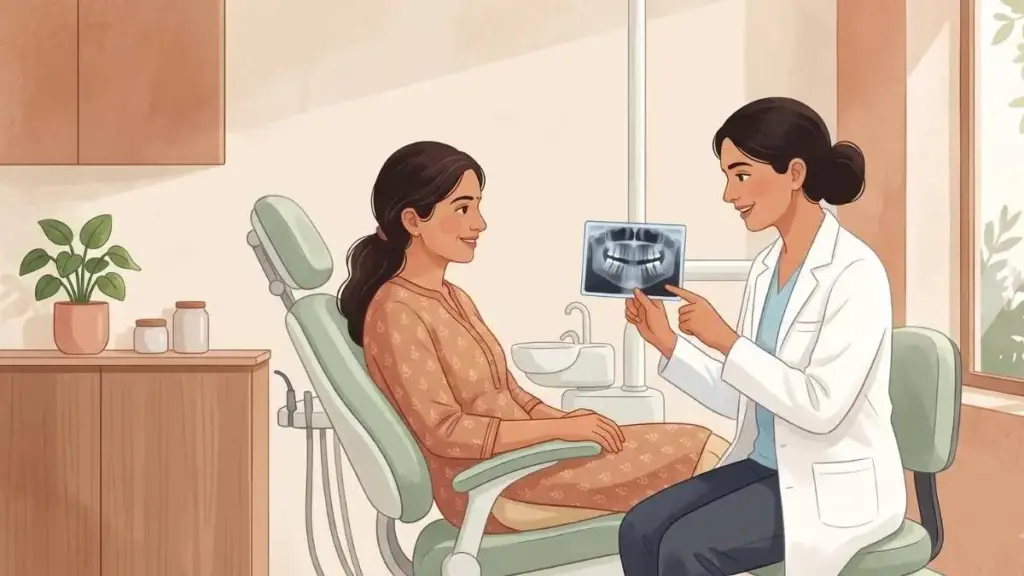
Short answer: A root canal is a way to save a tooth that’s badly decayed or infected, rather than pull it out. The dentist removes the damaged tissue inside, cleans and seals the space, and later fits a crown over it. The actual procedure takes 30 to 90 minutes depending on which tooth it is. With modern anaesthesia, it shouldn’t hurt during — and most people say it was less unpleasant than they expected.
Root canals have a reputation problem. The phrase itself has become shorthand for something painful and frightening, which makes it harder to go ahead with one when you actually need it. In practice, the procedure exists to stop pain — not cause it — and putting it off almost always makes things worse and more expensive.
Here is how the whole thing works, from the conversation where your dentist tells you it’s needed, to walking out afterwards.
Why a root canal becomes necessary
Inside every tooth, beneath the hard outer layers, is a soft tissue called the pulp. It contains nerves and blood vessels. When decay reaches the pulp, or the pulp gets infected through a crack or deep filling, it becomes inflamed and often extremely painful.
At that point, two things can fix it: remove the tooth entirely, or remove only the damaged pulp and keep the tooth. A root canal is the second option.
Common reasons your dentist may recommend one:
- Deep decay that has reached or is close to the pulp
- A tooth that throbs or aches without anything touching it
- Prolonged sensitivity to hot or cold that lingers for minutes, not seconds
- A small bump or swelling on the gum near a tooth
- A tooth that has darkened compared to its neighbours
- A cracked tooth where the crack extends into the pulp
Not all of these mean a root canal is definitely needed. Your dentist should explain what they found, what the alternatives are, and what happens if you do nothing. Ask.
Before the appointment
Get the treatment plan in writing
Before you agree, you should know the total cost — not just the root canal, but the crown that usually follows. These are billed separately, and together they represent the real cost of keeping the tooth. Ask for both numbers on paper.
Understand which tooth it is
Root canals on front teeth are simpler because they have one canal. Premolars have one or two. Molars — the large back teeth — have three or four canals and take longer. Your dentist should tell you which tooth is being treated and roughly how long it will take.
Ask whether a specialist is needed
General dentists do root canals regularly, but complex cases — curved canals, retreatments, cracked roots — may be referred to an endodontist, a specialist in this procedure. If your dentist recommends a specialist, that’s a sign of good judgment, not inability.
Eat beforehand
You won’t be able to eat comfortably for a couple of hours after, because your mouth will be numb. Have a normal meal before the appointment.
Take prescribed medication
Some dentists prescribe an antibiotic or anti-inflammatory a day or two before the procedure, especially if there’s an active infection. Take it as directed. If you weren’t prescribed anything, that’s normal too — not every case needs pre-medication.
The procedure, step by step
1. Anaesthesia (5 minutes)
The dentist numbs the area around the tooth with a local anaesthetic injection. This is a standard dental injection — the same one used for fillings — and is the only part that involves a needle.
If you’re anxious about the injection itself, say so. Many dentists apply a numbing gel to the gum before the needle, which dulls the sensation. The injection takes about thirty seconds, and the numbness sets in over the next few minutes.
You will be awake throughout. General anaesthesia is not used for root canals in India except in rare circumstances.
2. Isolation with a rubber dam (2 minutes)
A thin sheet of rubber is placed over the tooth, with a small hole punched for the tooth to stick through. This looks odd but serves an important purpose — it keeps saliva and bacteria out of the tooth during the procedure and prevents small instruments from being swallowed.
It stays on throughout and is removed at the end. Breathing through your nose is easier while it’s in place. If you have difficulty breathing through your nose, tell your dentist before they place it.
3. Accessing the pulp (5–10 minutes)
The dentist drills a small opening through the top of the tooth to reach the pulp chamber inside. You’ll hear the drill and feel vibration, but no pain — the anaesthesia handles that.
If at any point during the procedure you feel a sharp sensation rather than just pressure, raise your hand immediately. More anaesthesia can be given. This occasionally happens with teeth that are severely infected, because infection can make local anaesthesia less effective. It’s solvable, and your dentist would rather know than not.
4. Removing the pulp (10–20 minutes)
Using a series of very thin, flexible files — they look like tiny needles with a textured surface — the dentist removes the infected or dead pulp tissue from each canal inside the tooth.
This is the core of the procedure. The files are worked up and down each canal, and the canals are flushed repeatedly with an antiseptic solution (usually sodium hypochlorite) to dissolve remaining tissue and kill bacteria.
In many clinics, particularly with specialists, an electronic device called an apex locator is used to measure the exact length of each canal, and sometimes a dental microscope helps the dentist see inside the tooth in detail. You don’t need to ask for these — if the clinic has them, they’ll use them.
What you experience during this step: pressure, vibration, occasional beeping from instruments, the taste of the antiseptic rinse (kept away from your throat by the rubber dam), and time passing. Not pain.
5. Shaping and cleaning (10–15 minutes)
Once the pulp is out, the canals are shaped — widened slightly and tapered — so they can be filled evenly. More flushing happens. The dentist may take one or two X-rays during this step to check that the files have reached the full length of each canal.
These X-rays are quick — a small sensor placed beside the tooth, a second or two of exposure.
6. Filling the canals (5–10 minutes)
The cleaned canals are dried with tiny paper points (you won’t feel these) and filled with a rubber-like material called gutta-percha, along with a sealer paste. This fills the space where the pulp used to be and seals out bacteria.
The dentist may take a final X-ray to confirm the filling reaches the correct length in each canal.
7. Temporary or permanent filling (5 minutes)
The opening in the top of the tooth is sealed with a filling material. In most cases this is a temporary filling, because a permanent crown will be placed later. Some dentists place the permanent filling if the tooth is in good structural shape.
The rubber dam comes off. The dentist checks your bite and adjusts the filling if it feels too high when you close your mouth. Say if it does — even a tiny high spot becomes very annoying once the numbness wears off.
8. You’re done
The whole thing typically takes 30 to 60 minutes for a front tooth and 60 to 90 minutes for a molar. Some complex cases may be split across two appointments — the canals are cleaned and medicated at the first visit, then filled at the second, usually a week or two later.
After the procedure
The first few hours
Your mouth stays numb for two to four hours after. Avoid eating on that side until the numbness wears off — it’s easy to bite your cheek or tongue without feeling it.
Pain and medication
Some soreness around the tooth for two to five days is normal. It’s the tissues around the root recovering from the procedure, not a sign that something went wrong. It usually peaks on day two and fades.
Over-the-counter painkillers — ibuprofen or paracetamol, or both alternating — are usually enough. Your dentist may prescribe something stronger or an antibiotic if there was significant infection. Take what’s prescribed, for the full course.
If the pain increases sharply after the first few days rather than decreasing, or if swelling appears that wasn’t there before, call your dentist. That’s not normal recovery and may need attention.
Eating
Stick to soft food on the first day. After that, eat normally but avoid hard or crunchy food on the treated side until the permanent crown is placed. The tooth is structurally weaker without a crown and can crack under heavy biting force.
The crown
Most root canal treated teeth need a crown — a cap that fits over the tooth and protects it from cracking. This is usually done two to four weeks after the root canal, once the tooth has settled.
The crown is a separate procedure, a separate appointment, and a separate cost. Together, the root canal plus crown is the total investment in saving the tooth. It’s worth doing both — a root canal without a crown is like repairing a wall and not painting it. It works for a while, but the tooth is vulnerable.
How much does a root canal cost?
Costs vary significantly by city, by whether a general dentist or endodontist performs it, by which tooth it is, and by whether a microscope is used.
Typical ranges across Indian cities:
- Front tooth (single canal): ₹2,000 – ₹7,000
- Premolar (1–2 canals): ₹3,000 – ₹10,000
- Molar (3–4 canals): ₹4,000 – ₹15,000
A crown afterwards adds ₹3,000 – ₹18,000 depending on the material (PFM, zirconia, or E-max).
Metro cities tend to be at the higher end, tier-2 and tier-3 cities lower. Microscope-assisted root canals and specialist endodontists charge more, but the difference in precision can matter for difficult cases.
Check detailed dental treatment costs in your city →
Common fears, addressed plainly
“Root canals are extremely painful”
With modern anaesthesia, the procedure itself shouldn’t be painful. What was painful was the infected tooth before the root canal — and the root canal is what stops that pain. The soreness afterwards is manageable with normal painkillers and lasts a few days.
“Shouldn’t I just pull the tooth instead?”
It’s cheaper upfront, but the gap creates problems over time — adjacent teeth shift, the opposing tooth over-erupts, chewing efficiency drops, and replacing the missing tooth later (implant or bridge) costs significantly more than the root canal and crown would have. Saving a natural tooth is almost always preferable when possible.
“I’ve heard root canals cause other illnesses”
This claim originates from research in the 1920s that has been thoroughly discredited by modern science. Every major dental and medical association worldwide confirms that root canals are safe. The idea circulates on social media but has no current scientific support.
“What if it fails?”
Root canals have a success rate of roughly 85–95%. If it does fail — usually due to a missed canal, persistent infection, or a crack — it can often be retreated. Retreatment is more complex and costs more, but it’s still a viable option before considering extraction.
Questions to ask your dentist before the procedure
- Which tooth is it, and how many canals does it have?
- Will you do it or will you refer me to a specialist?
- What’s the total cost including the crown?
- Will it be done in one visit or two?
- Do you use a rubber dam? (The correct answer is yes.)
- Is an X-ray included in the cost?
Frequently asked questions
How long does a root canal take?
30 to 60 minutes for a front tooth, 60 to 90 minutes for a molar. Complex cases may require two visits. The time depends on how many canals the tooth has and whether there are complications like curved roots or calcified canals.
Does a root canal hurt?
The procedure itself shouldn’t, because the area is numbed with local anaesthesia. Some soreness for two to five days afterwards is normal and manageable with over-the-counter painkillers. If you feel sharp pain during the procedure, raise your hand — more anaesthesia can be given.
Do I need a crown after a root canal?
In most cases, yes. The tooth becomes more brittle after the pulp is removed, and a crown protects it from cracking. Front teeth occasionally survive without a crown if enough tooth structure remains, but molars almost always need one.
Can I eat after a root canal?
Wait until the numbness wears off (two to four hours) to avoid biting your cheek or tongue. After that, eat soft food on the first day and avoid hard or crunchy food on that side until the crown is placed.
How long does a root canal tooth last?
With a good crown and proper oral hygiene, a root canal treated tooth can last decades — often a lifetime. Regular dental check-ups help catch any issues early.
Is extraction better than root canal?
In most cases, no. Saving the natural tooth preserves your bite, prevents adjacent teeth from shifting, and avoids the cost of replacing the tooth later. Extraction is appropriate when the tooth is too damaged to save, but that’s a clinical judgment your dentist should explain.
Next step
If your dentist has recommended a root canal, the most useful thing you can do right now is get the treatment plan — including the crown — in writing with costs, and ask your questions before agreeing. If you want a second opinion, that’s entirely reasonable and any good dentist will support it.
Find a dental clinic near you →
About this article. This is a general description of the root canal procedure from the patient’s perspective, written with AI assistance. It contains no diagnosis, treatment advice or clinical recommendations. Procedures vary between clinics, and anything relating to your own teeth, symptoms, medications or treatment options should be discussed with a registered dental practitioner who has examined you.
Are you a practising dentist? We’re happy to publish a professional review note on this page with your name, qualification and clinic link. Get in touch.
